How Long Does It Take to Charge an EV with a Portable Charger?
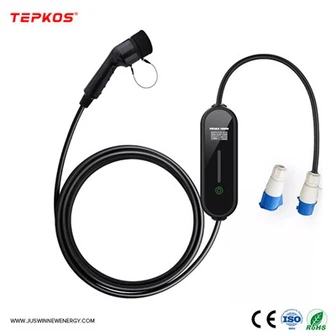
Generally speaking, the power output of portable EV chargers (such as portable Type 2 EV chargers) is relatively low, with common specifications ranging from 1.5 kW to 3 kW. Charging time varies significantly depending on the vehicle's battery capacity.
For example, a typical household electric vehicle with a battery capacity of around 50 kWh will theoretically take approximately 50 ÷ 1.5 ≈ 33.3 hours to fully charge using a 1.5 kW emergency electric car charger. If a 3 kW portable Type 2 EV charger is used, the charging time is reduced to about 50 ÷ 3 ≈ 16.7 hours.
However, actual charging time is influenced by energy loss during the process, so it is usually slightly longer than the theoretical calculation. In addition, residents in high-rise buildings may face limitations related to community power supply capacity. If many neighbors are using high-power appliances at the same time, the actual charging power may decrease, further extending charging duration.
Below are the key factors that determine EV charging time when using a portable charger:
1. Charger Power

Portable EV chargers are available in different power ratings, with 1.5 kW and 3 kW being the most common. Higher power output directly translates into faster charging for the same battery capacity.
For instance, a Type 2 portable EV charger is widely offered in these power ranges to meet both daily charging and emergency needs. For a vehicle with a 60 kWh battery, a 1.5 kW emergency electric car charger will take roughly 60 ÷ 1.5 = 40 hours to fully charge, while a 3 kW portable Type 2 EV charger can reduce the time to about 20 hours.
For users seeking faster charging without relying on public DC fast chargers, a 7 kW portable EV charger can be a practical upgrade. That said, it is important to confirm compatibility with both the vehicle and the available home or community power supply.
2. Vehicle Battery Capacity

Battery capacity varies widely among electric vehicles, ranging from several tens of kilowatt-hours to over one hundred kilowatt-hours. This is one of the most important factors affecting charging time.
For example, a vehicle with a 40 kWh battery will take about 40 ÷ 1.5 ≈ 26.7 hours to fully charge using a 1.5 kW Type 2 portable EV charger. In contrast, an 80 kWh battery charged with the same 1.5 kW emergency electric car charger will require approximately 80 ÷ 1.5 ≈ 53.3 hours.
Even when using a more powerful 7 kW portable EV charger, an 80 kWh battery will still take around 80 ÷ 7 ≈ 11.4 hours (after accounting for energy loss). While this is significantly faster than lower-power options, it still requires planning for overnight or extended charging periods.
3. Charging Energy Loss

During the charging process, a portion of energy is inevitably lost as heat or due to electrical resistance. As a result, actual charging time is always longer than the theoretical calculation. Energy loss typically ranges from 5% to 10%, depending on factors such as compatibility between the charger (for example, a portable Type 2 EV charger) and the vehicle, as well as environmental conditions like ambient temperature.
For instance, charging a 50 kWh battery with a 3 kW Type 2 portable EV charger has a theoretical charging time of 16.7 hours, but in practice, it may take approximately 17.5 to 18.4 hours due to energy loss. High-quality chargers, such as Nanjing JUSWIN's 7 kW portable EV charger, are designed to minimize these losses through efficient circuit design, helping deliver more stable and consistent charging performance.
4. Community Power Supply Conditions

Residents in high-rise buildings or older communities often encounter limitations related to power supply capacity. If multiple households are operating high-power appliances-such as air conditioners or electric water heaters-or using other portable EV chargers at the same time, grid voltage may drop. This can cause the actual output power of a portable Type 2 EV charger or emergency electric car charger to decrease.
For example, a 3 kW charger may operate at only 2.5 kW under unstable power conditions, increasing the charging time for a 50 kWh battery from 16.7 hours to around 20 hours. It is therefore advisable to assess community power load capacity before choosing a higher-power option like a 7 kW portable EV charger. Alternatively, selecting chargers equipped with built-in voltage stabilization features can help adapt to fluctuating power supplies.
Summary
Portable EV chargers offer flexibility and convenience, but charging time depends on multiple factors, including charger power, battery capacity, energy loss, and local power conditions. Understanding these variables helps EV owners choose the right portable charging solution and plan charging schedules more effectively.