Can a 7kW Home EV Charger Use a Standard Household Socket? Safe Setup & Correct Usage Guide
Can a 7kW Home EV Charger or Portable Charging Gun Be Used with a Standard Household Socket?
Correct Usage Methods for 7kW Charging Guns
A 7kW EV charger operates at an approximate current of 32A when connected to a standard 220V household voltage (calculated as 7000W ÷ 220V ≈ 32A).
However, standard household sockets are typically rated at 10A or 16A, and the copper core wiring commonly installed in residential walls usually has a cross-sectional area of 2.5 mm². The safe current-carrying capacity of such wiring cannot sustain a continuous 32A load.
Risks of Using a 7kW Charger with a Standard Household Socket
Forcing a 32A charging device to operate through a 10A or 16A household socket can lead to serious safety hazards, including:
Overheating of the socket and plug, increasing the risk of melting or fire;
Overheating of internal wiring, which may cause circuit breaker trips at best, or cable ignition at worst;
Fault warnings or automatic charging interruption triggered by the charging gun or the vehicle as a protective response.
Correct Usage Methods for a 7kW Charging Gun
To safely use a 7kW charging gun at home, the following conditions must be met:
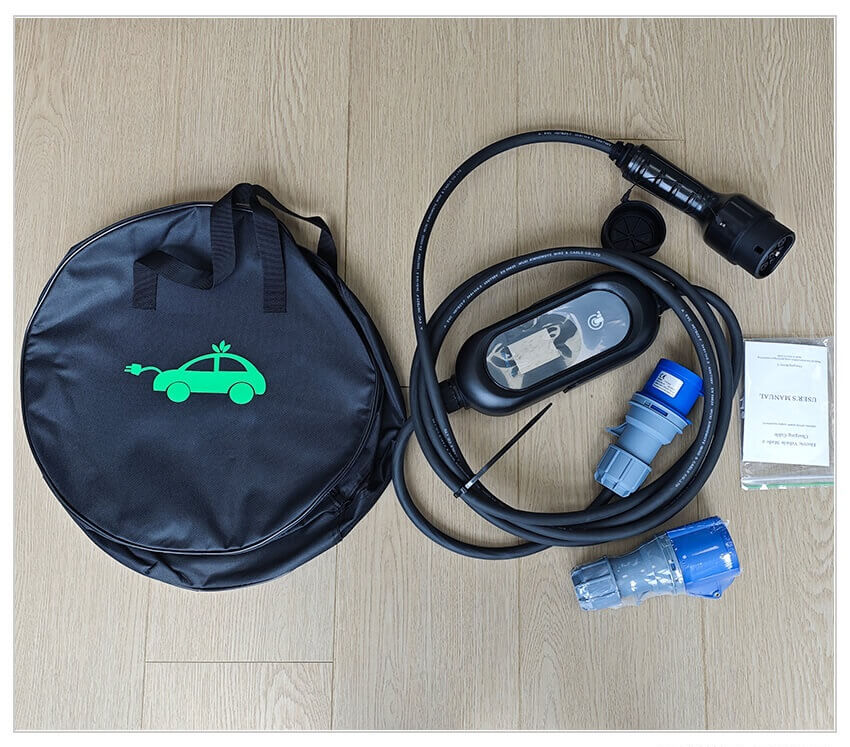
The socket used must not be a standard three-pin or five-pin household socket. Instead, it should be a dedicated high-current industrial socket, such as one compliant with IEC 60309 standards, commonly referred to as an industrial plug socket.
How to Set Up the Proper Circuit
Hire a licensed electrician to install a dedicated, independent circuit directly from the main household distribution board.
Wiring requirement: Use copper core cables with a cross-sectional area of no less than 6 mm² (6–10 mm² recommended).
Circuit breaker: Install a dedicated C32 or D32 air switch to provide reliable overcurrent protection.
Socket: Fit a 32A dedicated socket (such as an industrial socket) at the end of the circuit.
With this configuration, a 7kW charging gun can safely operate at full power, delivering approximately 7 kWh of electricity per hour, which typically adds 40–50 kilometers of driving range per hour of charging.
Summary and Recommendations
Direct use with a standard household socket?
Absolutely not. The safety risks are extremely high.
Optimal home solution:
Have a professional electrician install a dedicated circuit with a 32A industrial socket. This allows the 7kW charging gun to operate at full capacity and is the safest and fastest home charging option.
Cost-effective practical solution:
If your home already has a 16A air-conditioner socket, use a compatible adapter to charge at a reduced 3.5kW power level. This option requires no circuit modification and meets the daily charging needs of most EV owners.
Temporary emergency use:
If a 10A household socket must be used in an emergency, reduce the charging current to the minimum level (e.g., 8A or 10A) via the charging gun or adapter. Ensure continuous human supervision, and regularly check the socket and plug for overheating. Stop charging immediately if they become hot to the touch.
Safety first:
Regardless of the charging method, always ensure the earth (ground) wire is properly connected. This is a critical safety requirement and is usually checked by the charging gun before charging can begin.